Technology is moving incredibly fast.
In a few minutes, you can build a landing page, generate a pitch deck, create a launch video, produce animations, write hundreds of personalized emails and have AI agents contact more people than you could manually reach in weeks.
One thing hasn’t scaled at the same speed: human attention.
Your dream investor still has the same 24 hours. They still need to decide which companies deserve more of their time.
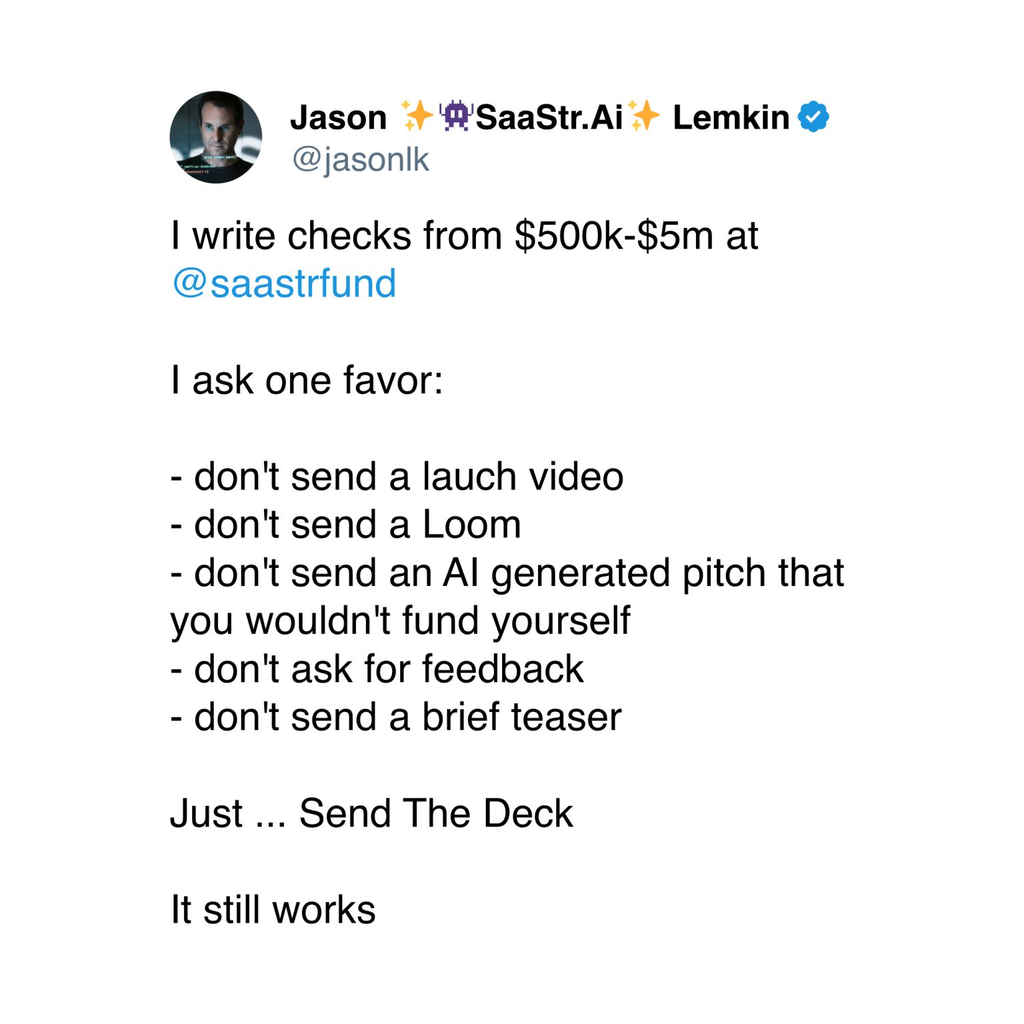
Image credit: Jason M. Lemkin
Why people invented pitch decks
Before pitch decks, founders relied on long business plans. Those documents could explain the company in detail, but they were too much for the first step.
Investors needed a faster way to answer one question:
Is this company worth a meeting?
So we started using 10–15 slides instead of 25-page business plans.
That is still the job of your pitch deck. You do not need to explain everything about your company. You need to give someone enough information to decide whether the next 30 minutes are worth it.
If you get the meeting, you will have time for the rest. You can explain the technology, show the product, open the financial model and answer the questions they actually care about.
The first deck only needs to get you there.
All these tools helped everyone
The first step is getting harder because all these new tools did not only help you. They helped every other founder too.
Launching a startup is easier. Building a polished landing page is easier. Creating a decent pitch deck is easier. Finding investors is easier. Reaching hundreds of them in one afternoon is easier.
You can create and send much more than you could five years ago.
So can everyone else.
More startups, same money, same attention
More founders can now reach the same investors, while the amount of capital and investor time stays limited.
That means more companies are competing for the same money and the same attention.
This is where I think founders sometimes make the first interaction harder than it needs to be.
You send a launch video, a Loom, a long deck and a website full of animations. Each one may be useful on its own. Together, they ask for a lot of time before the investor has decided whether they care.
You have more ways to explain your company now. You do not need to use all of them in the first message.
The first question is still simple: Is this worth another 30 minutes?
Pitch decks will evolve for investors, not founders
I believe pitch decks will evolve, but not because founders can now create fancier videos, animations or interactive pages.
They will evolve because investors need faster ways to filter the growing volume reaching them.
That is already happening.
Investors are using AI to review decks, extract information, summarize companies and filter opportunities before spending human time on them.
So the first reader of your deck may increasingly be AI.
That could change what we put inside decks. Maybe we add more detailed appendix slides that AI can analyze quickly. Maybe some information becomes more structured. Maybe we end up preparing one layer for machine review and another for human review.
The format will probably change around how investors review companies, not around how many fancy things founders can create.
The human part still needs to be simple
After the AI review, a human still has to look at your company and decide whether to spend more time on it.
That person still scans slides. They still miss things. They still get tired. They still have dozens of other companies asking for attention.
So the basic work inside a good deck stays useful.
Clear data visualization. The right number highlighted. Slide titles that tell you something. A story that moves without making the reader stop and decode it.
You can now create almost anything.
The harder part is deciding what your investor needs to understand first.
How long does it take a stranger to understand why you are worth 30 minutes?
Make that shorter.