How do investors actually read pitch decks?
Papermark analyzed 24,541 pitch decks, 358,672 investor views and more than 15 million page-level data points to understand what happens after founders send their decks.
The findings show that investors make decisions quickly:
- 16% of pitch deck views end in under 10 seconds.
- The average investor view lasts 4 minutes.
- Fewer than half of investors reach the final slide.
- Decks from companies that closed a round received 36 minutes of total investor attention, compared with 18 minutes for the typical deck.
- 26.5% of investors reopen a pitch deck on another day.
- The median time from sending a deck to its first open is 7.9 hours.
- 24% of decks are still unopened after three days.
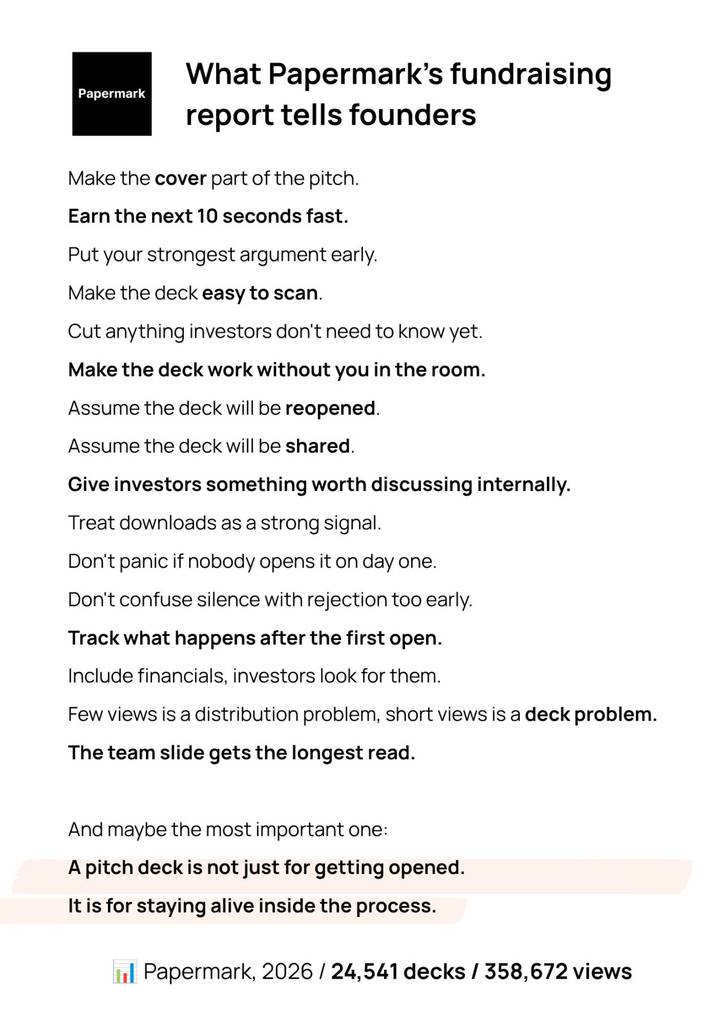
The lesson for founders is simple:
Your pitch deck needs to make the investment case quickly, clearly and without you in the room.
Here is what the data tells us about how investors read pitch decks and what founders should do differently.
How long do investors spend reading a pitch deck?
According to Papermark’s fundraising data, the average investor spends around four minutes per pitch deck view.
But the average hides an important pattern.
Investors often do one of two things:
They leave very quickly.
Or they decide the opportunity is interesting enough to read properly.
In fact, 16% of investor views end within the first 10 seconds.
That makes the beginning of your pitch deck disproportionately important.
If an investor cannot quickly understand what your company does, why it matters or why the opportunity deserves more attention, the rest of the deck may never be seen.
What founders should do
Your cover slide should do more than display:
Company Name
Pitch Deck 2026
Use the first few slides to communicate the strongest parts of the investment case.
That might be:
- unusual traction
- a major customer
- exceptional growth
- proprietary technology
- regulatory approval
- a major market shift
- strong founder-market fit
- another fact that fundamentally changes how the investor should evaluate the company
Do not hide your strongest argument on slide 9 because a standard pitch deck template tells you that’s where it belongs.
If something makes your company significantly more interesting, say it early.
Do investors read the entire pitch deck?
Usually, no.
Fewer than half of investors who open a pitch deck reach its final slide.
Papermark’s data shows the biggest drop happens near the beginning of the deck.
This has an important implication for pitch deck structure:
You cannot assume investors will patiently follow your preferred narrative until you eventually reveal the interesting part.
Your strongest information needs to appear early enough to survive investor drop-off.
Don’t bury the investment case
Imagine your company has:
- $1.5M ARR
- 3x year-over-year growth
- 90% customer retention
- a highly defensible technology
- three Fortune 500 customers
But the first five slides talk mostly about the general industry problem.
You are making investors work too hard to discover why they should care.
A pitch deck is a decision-making tool.
Help investors understand the opportunity as quickly as possible.
How long should a pitch deck be?
Papermark’s data suggests a practical range of approximately 9 to 16 slides.
Twelve-slide pitch decks performed particularly well in its dataset, combining high view counts with relatively strong completion and return-view rates.
That does not mean every startup needs exactly 12 slides.
A biotech company, deep-tech startup and straightforward B2B SaaS company may need different amounts of information.
The more useful principle is:
Include enough information to make the investment case, but not so much that important information gets buried.
Anything non-essential can usually move into an appendix or your investor data room.
Successful pitch decks receive more investor attention
One of the most interesting findings in Papermark’s report is the difference in total attention.
The typical pitch deck accumulated around 18 minutes of investor attention.
Decks associated with companies that later closed a funding round accumulated around 36 minutes.
That does not mean an investor sat down and read a successful deck continuously for 36 minutes.
Total attention can accumulate across several investors and multiple visits.
That distinction is important.
A serious fundraising process might look like this:
An investor opens your deck.
They return to it later.
They share it with a partner.
The partner reviews it.
Someone returns to your financials before a meeting.
The deck appears again during an internal discussion.
The pitch deck is no longer simply a presentation.
It becomes part of the investor’s decision-making process.
26.5% of investors reopen pitch decks
More than one in four investors reopen a pitch deck on another day.
This is another reason founders should stop thinking about a pitch deck as something an investor reads once.
Investors may return while:
- preparing for a founder meeting
- comparing investment opportunities
- checking a specific metric
- discussing the startup internally
- reviewing the company before an investment committee
- conducting further diligence
And when they return, you probably will not be there to explain the slides.
Make your pitch deck work without you
Every important slide should make sense as a standalone document.
A simple test I use is the read-the-titles-only test.
Read only the slide titles from beginning to end.
Do they communicate an investment story?
Compare:
Traction
with:
We reached $1.2M ARR with 3x growth in 12 months
Or:
Market
with:
A $4.2B market is moving from manual workflows to AI
The second version tells the investor what they should understand from the slide.
Your titles should carry arguments, not merely label topics.
How quickly do investors open pitch decks?
Founders often assume that silence means rejection.
The data suggests you should be careful with that assumption.
Papermark found that the median time to the first pitch deck open is 7.9 hours.
And 24% of pitch decks are still unopened after three days.
So if an investor has not replied after 24 hours, they may not have evaluated the company at all.
They might simply not have opened the deck yet.
When should you follow up with an investor?
There is no universal follow-up schedule, but investor activity can give you additional context.
A founder who knows that an investor has:
- never opened the deck
- opened it for eight seconds
- read the entire deck
- returned three days later
- forwarded it
- downloaded it
has much more information than a founder looking only at their inbox.
This is where pitch deck analytics become useful.
What investor pitch deck signals should founders track?
An open is only the beginning.
What happens after the first open can provide additional signals about investor engagement.
1. Repeat views
If an investor returns to your pitch deck on another day, they are engaging with the material again.
That does not guarantee investment.
But a repeat visit is different from a single short view.
2. Time spent on the deck
A 10-second visit and a four-minute read should not be interpreted in the same way.
Time spent can help you understand whether investors are actually examining the opportunity.
3. Slides viewed
Page-level pitch deck analytics can show which sections receive attention and where readers stop.
If investors consistently leave during the opening slides, the problem may be very different from investors who carefully read the entire deck but never respond.
4. Forwarding
If a pitch deck is shared with another person, the company may be moving into a broader conversation.
The context still matters, but internal sharing can be a useful fundraising signal.
5. Downloads
A downloaded pitch deck may be moving into another part of an investor’s workflow, such as offline review or an internal discussion.
No individual signal proves investor intent.
Look at the pattern instead.
Why pitch deck analytics matter
Without document analytics, fundraising can feel binary:
They replied.
Or:
They didn’t reply.
But there can be a lot happening between those two outcomes.
Imagine two investors.
Investor A opens your deck for six seconds and never returns.
Investor B reads the full deck, returns two days later and shares it with someone else.
Your inbox might still show the same thing:
No reply.
But those are very different situations.
Understanding investor engagement can help founders prioritize follow-ups and understand how their pitch deck is performing after it leaves their hands.
You can explore the complete dataset in Papermark’s Fundraising Report.
What does the data tell us about building a better pitch deck?
The biggest lesson from 24,541 pitch decks is not that you need a particular template.
It is that investor attention is limited and nonlinear.
Some investors leave almost immediately.
Others read carefully.
Some return days later.
Your deck may be passed to someone who has never spoken to you.
So build for all of those scenarios.
Put your strongest evidence early
If traction fundamentally changes the investment case, do not wait until slide 8 to reveal it.
Make every slide easy to scan
Investors should quickly understand the main point without decoding a wall of text.
Use slide titles to make your argument
“Market” tells me what the slide is about.
“$4B of spending is shifting to software” tells me why I should care.
Don’t depend on your verbal explanation
Your pitch deck may be read while you are asleep.
It needs to make sense without your voiceover.
Keep the story consistent
Your traction slide, financial model, market assumptions and investor data room should support the same investment case.
The deeper an investor goes, the more evidence they should find behind the claims made in your pitch.
Track what happens after you send your pitch deck
Sending a pitch deck should not necessarily be the end of your visibility into the process.
With document tracking, you can understand when investors open the deck, how they interact with it and whether they return later.
If you want that visibility for your own fundraising process, you can share your pitch deck and build your investor data room with Papermark.
You can start for free, and the link includes 20% off premium plans for the first three months.
Frequently Asked Questions About How Investors Read Pitch Decks
How long do investors spend on a pitch deck?
Papermark’s analysis of 358,672 investor views found an average viewing time of approximately 4 minutes per pitch deck view. However, 16% of views ended within the first 10 seconds, showing how important the opening slides are.
Do investors read the entire pitch deck?
Many do not. Fewer than half of investors in Papermark’s dataset reached the final slide, which means founders should avoid saving their most important evidence for the end of the deck.
How many slides should a pitch deck have?
Papermark’s data suggests 9 to 16 slides is a useful range, although the right pitch deck length depends on the complexity and stage of the company. Twelve-page decks performed particularly well in the dataset.
How quickly do investors open pitch decks?
The median time from sending a deck to the first investor open was 7.9 hours. About 24% remained unopened three days after being sent.
Do investors look at pitch decks more than once?
Yes. 26.5% of investors reopened a pitch deck on another day, showing that fundraising decks often remain part of the evaluation process beyond the first read.
What should be on the first slide of a pitch deck?
The first slide should make it immediately clear what the company does. When possible, it should also communicate a strong reason to keep reading, such as notable traction, a distinctive advantage or another important part of the investment case.
Can founders track who views their pitch deck?
Pitch deck sharing platforms can provide analytics such as opens, viewing time, page-level engagement and return visits. Papermark provides pitch deck sharing and document analytics alongside virtual data room functionality.
Final takeaway
Investors do not read pitch decks like founders build them.
Founders often think in slides:
Problem.
Solution.
Market.
Product.
Traction.
Team.
Ask.
Investors are deciding whether the opportunity deserves another minute of attention.
That is why the most important question is not:
“Did I include every standard pitch deck slide?”
It is:
“Can an investor understand why this company is worth considering before I lose their attention?”
Build around that question.
Because once you send your pitch deck, it has to pitch without you.